In This Article
- What Is Autism? A Simple, Fear-Free Explanation
- How Common Is Autism in India?
- Early Signs of Autism in Toddlers
- A Note on Girls and Autism
- What Should Indian Parents Do If They Suspect Autism?
- Why Early Intervention Changes Everything
- How CRIA Foundation Supports Families Across India
- Frequently Asked Questions (FAQ)
1. What Is Autism? A Simple, Fear-Free Explanation
Autism, or Autism Spectrum Disorder (ASD), is a neurodevelopmental condition that affects how a person thinks, communicates, and experiences the world.
The word ‘spectrum’ is everything. Autism does not look the same in every child. Some children are non-verbal. Others speak fluently but struggle to understand social cues. Some are extraordinarily sensitive to sound, texture, or light. Others show breathtaking focus and ability in specific areas.
No two children with autism are exactly alike, and that is not a problem. It is simply the truth of human variation. Autism is not a disease. It is not caused by bad parenting, by vaccines, or by anything you did or didn’t do.
The World Health Organisation describes autism as a condition present from early childhood that affects how individuals communicate, relate to others, and experience the world around them.
“Neurodiversity simply suggests that there is no one right way of thinking, learning, and behaving.”
— CRIA Foundation
At CRIA Foundation, we have worked with neurodiverse children and families since 2006. Our mission has always been to practice and promote joyful, effective teaching and learning strategies, guided by science, and grounded in compassion.
2. How Common Is Autism in India?
Studies estimate that approximately 1 in 68 children in India is on the autism spectrum, though experts believe this number significantly underestimates reality due to widespread underdiagnosis, limited specialist access in rural areas, and cultural stigma that prevents families from seeking help.
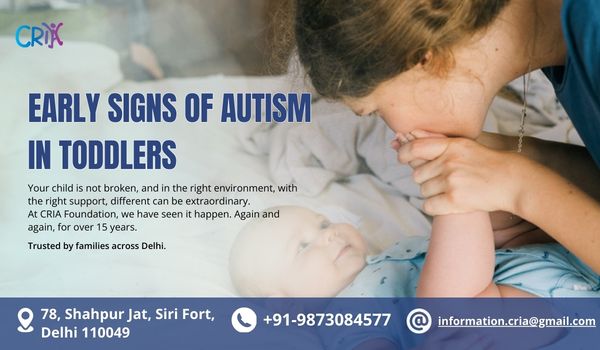
3. Early Signs of Autism in Toddlers
Early identification is vital. Here are some of the most common red flags Indian parents should look for in toddlers (ages 18 months to 3 years):
Social and Communication Signs:
- Limited Eye Contact: They may avoid looking at you directly or for very long.
- Lack of Response to Name: By 12 months, most children turn when called; a child with autism may seem “deaf” to their name while hearing other sounds perfectly.
- Difficulty with Gestures: They may not point at things they want or wave goodbye.
- Preference for Solitude: They seem to be in “their own world” and show little interest in playing with other children.
- Delayed Speech: They may not be using single words by 16 months or two-word phrases by 24 months.
Behavioural and Sensory Signs:
- Repetitive Movements: Flapping hands, rocking, or spinning in circles.
- Intense Focus on Parts: Instead of playing with a toy car, they might spend hours just spinning the wheels.
- Need for Routine: Becoming extremely upset if the route to school changes or if a toy is moved.
- Sensory Sensitivity: Covering ears at the sound of a pressure cooker or vacuum cleaner, or having an intense dislike for certain clothing textures.
4. A Note on Girls and Autism
It is important to note that autism often looks different in girls. Girls are often better at “masking” or imitating social behaviours, which means they are frequently diagnosed much later than boys. They may have quieter interests that don’t immediately look like “typical” autism but still struggle with social exhaustion and anxiety.
5. What Should Indian Parents Do If They Suspect Autism?
If you have concerns, do not wait for your child to “grow out of it.” The first step is a formal screening. In India, you can reach out to:
- A Developmental Paediatrician.
- A Child Psychiatrist or Clinical Psychologist.
- Specialised centres like CRIA Foundation offer an initial consultation and guidance.
Standardised tools like the ISAA (Indian Scale for Assessment of Autism) or the M-CHAT are used to provide an accurate diagnosis.
6. Why Early Intervention Changes Everything
The toddler brain is incredibly “plastic”, meaning it is highly adaptable. Early Intervention (usually before age 5) can significantly improve a child’s ability to communicate, learn, and live independently.
At CRIA Foundation, we focus on evidence-based approaches like Applied Behaviour Analysis (ABA), which helps children build functional skills in a structured, positive way.
7. How CRIA Foundation Supports Families Across India
Since 2006, CRIA Foundation has been a beacon of support for neurodiverse families. We provide:
- Direct Child Services: Individualised support plans tailored to your child’s unique needs.
- Professional Training: Building a community of skilled educators and therapists across India.
- Parental Support: Helping you navigate the emotional and practical journey of raising a child with autism.
8. Frequently Asked Questions (FAQ)
Is autism curable?
Autism is not a disease, so there is no “cure.” However, with the right support and therapies, children can learn to manage challenges and lead fulfilling, independent lives.
Is my child’s autism my fault?
Absolutely not. Science shows that autism is primarily genetic and biological. Nothing a parent does causes autism.
When should I start therapy?
As soon as possible. Research consistently shows that starting intervention the moment concerns are raised leads to the best long-term outcomes.